What an Irish small business website actually needs in 2026
An Irish small business website in 2026 needs six things: one clear page per service, a page that says who you are, a contact or booking route that works on a phone, load times under two seconds, marked-up business details, and a Google Business Profile that matches the site. Everything else is optional.
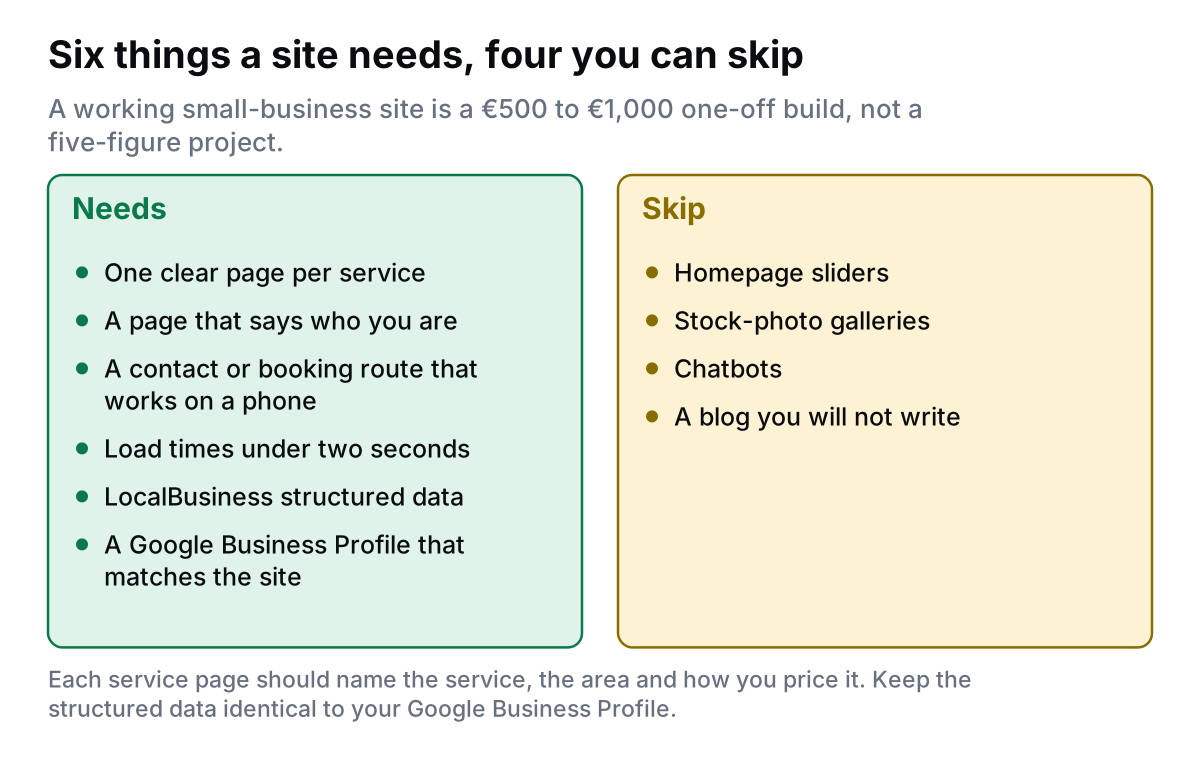
Most small sites fail on the basics rather than the extras. They have a slideshow nobody watches, no page for the service that pays the bills, and a contact form that goes to an inbox nobody checks. This guide is the minimum list I build to, in the order it matters. If you want to see the finished shape first, have a look at the demo sites.
What pages does a small business website actually need?
Five page types cover almost every trade and practice. Add more only when there is a real question they answer.
- Home. What you do, where you do it, and how to reach you, all visible without scrolling. Not a welcome message.
- One page per service. This is where the work comes from. Boiler repair, bathroom fit-outs and emergency call-outs each deserve their own page, because each one is a different search and a different question.
- About. A real name, a real photo, how long you have been trading, and the counties you cover. This is the page that decides whether a stranger trusts you.
- Contact. Phone, email, hours, area covered, and a short form. Nothing clever.
- Reviews or work done. Honest reviews and a handful of real job photos. Six specific examples beat sixty stock images.
If you cover several towns and genuinely serve them differently, a page per area can earn its place. If it would be the same page with the town name swapped, do not build it. Thin duplicate pages help nobody.
How fast does it need to be?
Fast enough that nobody notices it loading. In practice that means the main content appearing in under two seconds on a phone on mobile data. Google's Core Web Vitals set the thresholds most people work to: Largest Contentful Paint under 2.5 seconds, Interaction to Next Paint under 200 milliseconds and Cumulative Layout Shift under 0.1.
Small sites get slow for predictable reasons. Photos uploaded straight off a phone at full size. A page builder loading half a megabyte of code to draw a button. Four tracking scripts. A web font family with six weights. Strip those and a small site loads almost instantly, on any host.
Speed is also a conversion issue rather than only a ranking one. Someone standing in a flooded kitchen looking for an emergency plumber will not wait for your hero video.
What does mobile first mean in practice?
It means you design and check the phone version first, and the desktop version second. Google indexes the mobile version of your site, and has done for years under mobile-first indexing, so the phone layout is the version that counts.
The practical checks are short. Body text readable without pinching. Tap targets big enough for a thumb. Phone number tappable as a link. No horizontal scrolling. Forms that do not fight the on-screen keyboard. Test on a real handset, outdoors, on mobile data, not only in a desktop browser resized narrow.
What structured data do you need?
Only a little, and it makes a real difference to how machines read you. Structured data is a block of code that states your business facts in a form software can parse, using the vocabulary described in Google's introduction to structured data markup.
For a small business, three types cover it:
- LocalBusiness for your name, address, phone, opening hours, area served and price range.
- Service on each service page, so the page states plainly what is offered.
- FAQPage where you have a genuine question and answer block, worded exactly as it appears on the page.
Two rules. Keep the marked-up facts identical to the visible text, and identical to your Google Business Profile. Contradictions are worse than no markup at all. This is also the groundwork that decides whether AI assistants can identify you, which is covered in what AI search visibility means.
How should the site connect to your Google Business Profile?
Treat the profile as part of the website, not a separate chore. The two should agree on every fact: trading name, address, phone, hours, services and the areas you cover. Link the profile to the right page, so a profile entry for bathroom fit-outs points at your bathroom page rather than the homepage.
Then keep asking customers for honest reviews. Reviews are the one signal you cannot build yourself, and they feed both map results and AI answers, which is where AI search visibility work picks up.
How should customers contact or book?
Give people at least two routes and put them where the eye lands. A tappable phone number in the header is still the highest-converting element on most trade sites. Add a short form of four or five fields, and WhatsApp if that is how your customers already talk to you.
Booking is worth building only when it saves you calls. A clinic, a salon or a garage with fixed appointment slots should have it. A builder quoting bespoke jobs should not, because every enquiry needs a conversation anyway. If you do add booking, make sure the confirmation email actually sends and that no-shows get a reminder.
One thing to check on day one: where do enquiries land, and who reads them? A form posting to an address nobody monitors is the most expensive fault a small site can have.
What can you skip in 2026?
- Sliders and carousels. Visitors read the first slide and scroll past. They cost speed and gain nothing.
- Stock photography. Three real photos of your own work outperform a library of models in hard hats.
- A blog you will not write. An empty blog with two posts from 2023 reads as abandoned. Only start one if you will publish.
- Chatbots. On a five-page site they mostly get in the way of the phone number.
- Custom design systems and animation. Nice to look at, invisible to the customer deciding whether to ring you.
- Cookie banners you do not need. If you drop no marketing cookies, do not add the banner. Fewer trackers is the better answer.
What should this cost?
Less than most people expect. FMOps builds are a one-off cost: €500 for a single page, €750 for several service pages, and €1,000 for a full site with a booking or quote flow. Content is gathered in one session, you get a draft to review inside the week, and two rounds of changes are included. You own the domain and the files, with no lock-in.
After launch there are running costs whether or not you pay anyone: the domain, hosting, and someone to make changes. An optional care plan covers hosting, backups, security updates and small edits from €50 a month, rising to €75 and €100 for plans that include new pages. It is never bundled into the build price.
For the wider market picture, including agency and freelance ranges and the Local Enterprise Office Trading Online Voucher Scheme, see our breakdown of small business website costs in Ireland.
See what this looks like built
Have a look at the demo sites, then read the three website tiers and what each one includes. If you would rather just talk it through, book a free 30-minute call and I will tell you which tier fits, or whether a website is not what you need right now.
Frequently asked questions
How many pages does a small business website need?
Five page types cover most businesses: home, one page per service, about, contact, and reviews or work done. Add location pages only if you genuinely serve those areas differently.
How fast should a small business website load?
The main content should appear in under two seconds on a phone on mobile data. Most small sites are slow because of full-size photos, page builder code and too many tracking scripts rather than cheap hosting.
Do I need structured data on a five-page website?
Yes, and only a little. LocalBusiness markup for your details, Service markup on each service page, and FAQPage markup where you have a real question and answer block. Keep the marked-up facts identical to the visible text and to your Google Business Profile.
Do I need a blog on my business website?
Only if you will actually publish. An abandoned blog with two old posts makes a business look closed. Two or three strong service pages are worth more than a neglected blog.
What does a small business website cost in Ireland?
An FMOps build is a one-off cost of €500 for a single page, €750 for several service pages, or €1,000 for a full site with a booking or quote flow. An optional care plan for hosting, backups and small changes starts at €50 a month.

Fionn Murphy runs FMOps, a one-person consultancy in Waterford, Ireland. He helps small Irish businesses get found in AI search, ship simple websites, automate admin, and set up Claude for their teams. LinkedIn · Book a free 30-minute call