Time Management for Business Owners: 10 Strategies
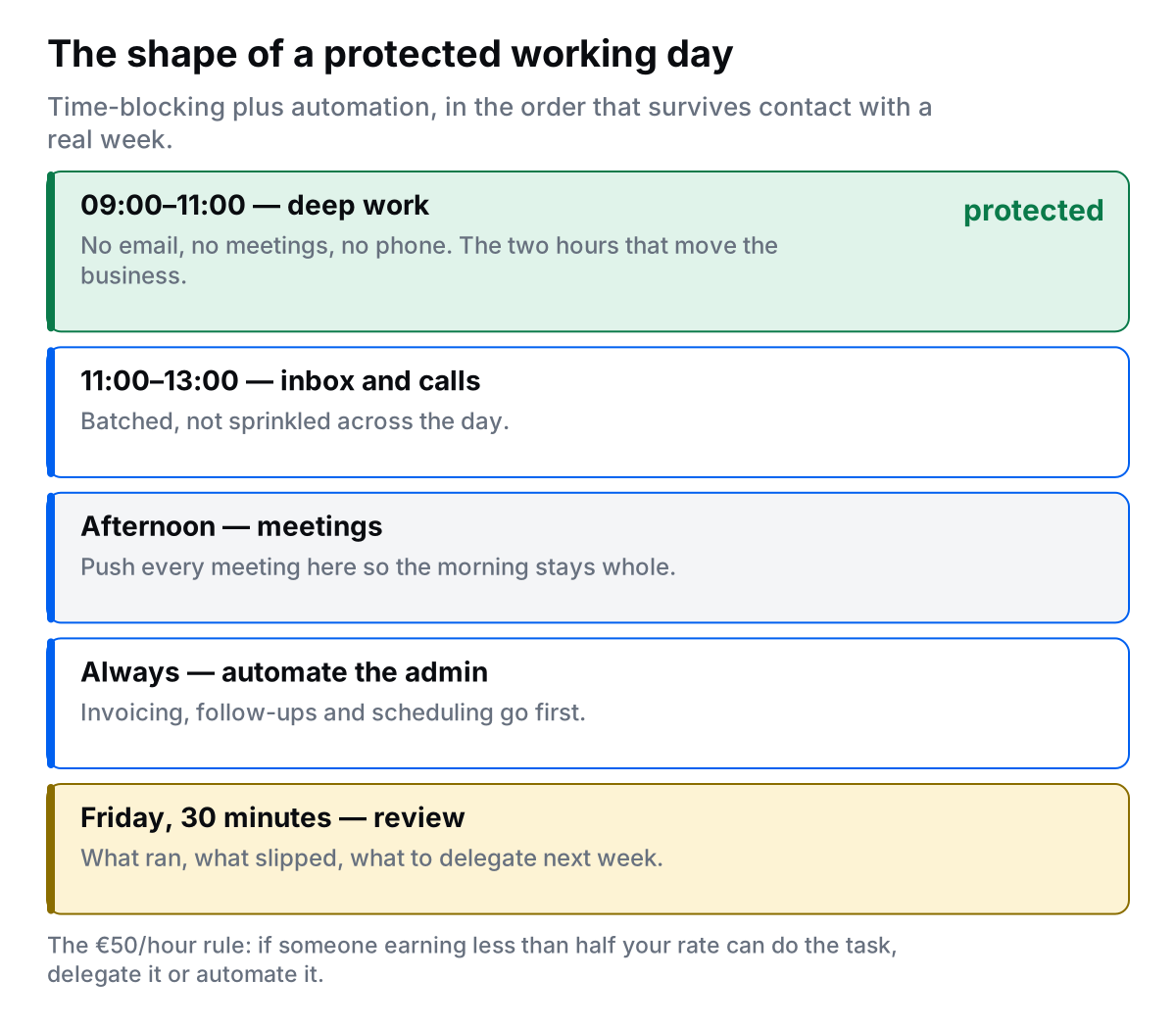
Direct answer: The most effective time management strategy for Irish business owners is time-blocking combined with automation: Block 9-11am daily for deep work (no email/meetings), automate recurring tasks (invoicing, follow-ups, scheduling), and use the €50/hour rule for delegation (if task can be done by someone earning <€50/hour, delegate it). This saves 15-20 hours weekly and increases revenue-generating time by 40-60%.
If you are working 60+ hours weekly but feel like you are not moving forward, you have a time management problem, not a time problem.
I run FMOps on my own from Waterford, so the methods below are ones I have had to use myself.
The time tends to disappear into:
- Email and Slack (reactive work, not strategic)
- Meetings that could be emails
- Admin tasks (invoicing, scheduling, data entry)
- Context-switching (doing 20 things badly vs. 3 things excellently)
- "Firefighting" (reacting to urgent but unimportant tasks)
This guide shows 10 time management strategies that actually work for Irish business owners in 2026.
10 Time Management Strategies for Irish Business Owners
1. Time-Blocking: Protect Your Deep Work Hours
The Problem: Your calendar is full of meetings. You do "real work" after 6pm when everyone leaves.
The Solution:
- Block 9-11am daily for deep work (strategic thinking, important projects, revenue-generating activities)
- Block 2-4pm for meetings/calls
- Block 11am-12pm and 4-5pm for email/Slack/admin
- Treat blocks like appointments, do not move them
Why It Works: Deep work requires 90-120 minutes of uninterrupted focus. Context-switching kills productivity. Batching similar tasks (all meetings in one block, all email in another) saves mental energy.
How to Start:
- Open Google Calendar
- Create recurring block: "Deep Work" 9-11am daily
- Mark as "Busy" so people cannot book over it
- Add note: "No meetings during this time, focus work only"
2. The €50/Hour Rule: Delegate Everything Below Your Hourly Value
The Problem: You are doing €20/hour tasks (data entry, admin, basic design) when your time is worth €100-200/hour in business development.
The Solution:
- Calculate your hourly value: Annual revenue target ÷ 2,000 hours = €/hour
- Example: €200k revenue goal ÷ 2,000 = €100/hour
- Any task that can be done by someone earning under 50% of your rate = delegate
What to Delegate (for Irish SMEs):
| Task | Cost to Delegate | Your Opportunity Cost |
|---|---|---|
| Bookkeeping | €25-40/hour (accountant) | €100+/hour in lost sales time |
| Social media posting | €15-25/hour (VA) | €100+/hour |
| Email management | €20/hour (VA) | €100+/hour |
| Scheduling/calendar management | €0 (automate with Calendly) | €100+/hour |
3. Automate Recurring Tasks
The Problem: You manually do the same tasks every week (invoicing, follow-ups, social posts, reports).
The Solution: Automate Everything Possible
Top Automations for Irish Business Owners:
- Invoicing: Xero/QuickBooks recurring invoices
- Payment reminders: Automated email sequences
- Meeting scheduling: Calendly, which removes the back-and-forth entirely
- Email follow-ups: HubSpot/Mailchimp sequences
- Social media: Buffer/Hootsuite scheduling
- Expense tracking: Xero mobile app receipt capture
- CRM updates: Zapier automation
4. The Two-Hour Rule: No Meetings Before 11am
The Problem: 9am meeting → you are in reactive mode all day. No time for strategic thinking.
The Solution:
- Block 9-11am for deep work (NO meetings, calls, or Slack)
- Schedule meetings 11am-4pm only
- Use Calendly with availability constraints to enforce this
Why It Works: Morning hours = peak cognitive performance. Use them for important work (strategy, complex projects, revenue-generating activities), not status updates.
5. Eisenhower Matrix: Prioritize Ruthlessly
The Problem: Everything feels urgent. You work on whatever is loudest, not what is most important.
The Solution: Use Eisenhower Matrix
| Urgent | Not Urgent | |
|---|---|---|
| Important | DO NOW Crises, deadlines, pressing problems |
SCHEDULE Strategy, planning, relationship building |
| Not Important | DELEGATE Interruptions, some emails, some calls |
DELETE Time wasters, busywork, distractions |
Most Business Owner Time Wasted: Quadrant 3 (Urgent/Not Important): other people's priorities, interruptions, non-essential emails
Where You Should Spend Time: Quadrant 2 (Important/Not Urgent): strategy, business development, systems building
6. Batch Similar Tasks Together
The Problem: You switch between tasks constantly (email → meeting → social post → invoice → email). Context-switching is expensive.
The Solution: Batch Similar Tasks
- Email: Check 2x daily only (11am-12pm, 4-5pm). Close email app otherwise.
- Meetings: Schedule all meetings Tuesday/Thursday 2-5pm. Keep Monday/Wednesday/Friday meeting-free.
- Content creation: Write all social posts for the week on Monday morning (1 hour batch = 5 days of content).
- Invoicing: Do all invoices Friday afternoon (not throughout week).
- Admin: Batch all admin tasks Friday 4-5pm (expenses, receipts, filing).
Why It Works: Reduces context-switching overhead. Similar tasks use similar mental models, easier to stay in "flow."
7. The "One Big Thing" Rule
The Problem: To-do list with 30 tasks. You complete 15 small tasks but miss the one thing that actually moves the needle.
The Solution:
- Every morning, identify ONE task that, if completed today, makes everything else easier or unnecessary
- Do that ONE thing during your first deep work block (9-11am)
- Everything else is secondary
Examples of "One Big Thing":
- Send proposal to €50k prospect
- Finish product feature that unblocks launch
- Have difficult conversation with underperforming team member
- Finalize pricing for new service offering
Not "One Big Thing": Respond to emails, attend status meeting, update CRM
8. Say "No" More Often (Protect Your Calendar)
The Problem: You say "yes" to every meeting, coffee chat, and favor. Your calendar is controlled by others.
The Solution: Default to "No"
Before saying "yes" to any meeting, ask:
- Is this urgent AND important? (Eisenhower Quadrant 1)
- Can this be handled via email/Slack instead?
- If I say yes, what am I saying no to? (Opportunity cost)
Polite Irish Ways to Say No:
- "I would love to help, but I am fully committed this quarter. Can we revisit in [Month]?"
- "I am not the best person for this, have you tried [Name]?"
- "Can we handle this via email? I am trying to protect focus time."
- "I am not taking new commitments until [Date]. Let's reconnect then."
9. Use "Power Hours" for Admin Batching
The Problem: Admin tasks (email, expenses, invoices, filing) eat up 2-3 hours daily in 15-minute chunks throughout the day.
The Solution: 2 Power Hours Weekly
- Friday 4-5pm: All admin tasks (expenses, receipts, invoices, filing)
- Friday 5-6pm: Email zero, clear Slack, review next week's calendar
What to Handle:
- Submit all expense receipts (use Xero mobile app, snap and done)
- Process all invoices for the week
- Respond to non-urgent emails
- File documents, clear desktop
- Review next week, block deep work time
10. Weekly Review: 30 Minutes Every Friday
The Problem: You are busy all week but not sure what you actually accomplished. Same problems repeat weekly.
The Solution: 30-Minute Weekly Review
Every Friday, 3:30-4pm:
- Review week (5 min): What worked? What did not? What took more time than expected?
- Clear inbox/tasks (10 min): Archive completed tasks, defer non-urgent items
- Plan next week (10 min): Identify "One Big Thing" for each day, block deep work time
- Update systems (5 min): Add new automations, delegate new recurring tasks
Want Help Implementing Time Management Systems?
I will audit your calendar, build automation workflows, and create a custom time management system in 2 weeks.
Not sure what to automate first? Run the free automation audit. It takes five minutes and shows the hours and euro you would get back.
If step three is where the hours go, start with the guides on automating Xero, automated appointment reminders and the tools sole traders actually need.
Implementation Plan: 4 Weeks
Week 1: Foundation
- Track all time for 5 days (use Toggl or spreadsheet)
- Calculate your €/hour value
- Identify top 5 time wasters
- Block 9-11am deep work starting Monday
Week 2: Automation & Delegation
- Automate 3 recurring tasks (invoicing, scheduling, email sequences)
- Delegate 2 admin tasks (bookkeeping, social media, or email management)
- Implement email batching (11am-12pm, 4-5pm only)
Week 3: Meetings & Priorities
- Reschedule all standing meetings to Tuesday/Thursday 2-5pm blocks
- Start "One Big Thing" practice (identify each morning)
- Say "no" to at least 3 meeting requests this week
Week 4: Systems & Review
- Set up Friday Power Hour (4-6pm admin batching)
- Do first weekly review (Friday 3:30-4pm)
- Audit results: Compare time tracking from Week 1 vs. Week 4
FAQs
What is the best time management technique for busy business owners?
Time-blocking: Schedule specific tasks in calendar blocks (e.g., 9-11am = deep work, 2-3pm = meetings). Treat blocks like appointments. Prevents context-switching and protects focused work time. Most effective for Irish business owners managing multiple priorities.
How can I save time on repetitive business tasks?
Automate recurring tasks using tools like Zapier, HubSpot workflows, or Xero automation. Common automations for Irish SMEs: invoicing, payment reminders, email follow-ups, social media posting, meeting scheduling. It removes the repetitive part of the week.
Should I delegate more as a business owner?
Yes. Use the €50/hour rule: If a task can be done by someone earning <€50/hour, delegate it. For Irish business owners earning €100+/hour (or worth that much in business development), admin tasks are costing you €50+ per hour in opportunity cost. Delegate or automate.
How do I prioritise when everything feels urgent?
Use Eisenhower Matrix: Urgent + Important = do now. Important + Not Urgent = schedule time. Urgent + Not Important = delegate. Not Urgent + Not Important = delete. Most business owner time is wasted in Urgent/Not Important quadrant (other people's priorities).
What is the biggest time management mistake Irish business owners make?
Checking email first thing in the morning. Starts day in reactive mode responding to others' priorities. Instead: 9-11am = deep work on YOUR priorities (no email, Slack, or phone). Handle email/messages 11am-12pm and 3-4pm only.
Final Thoughts
You do not need to work 60-70 hours weekly to grow your business.
You need better time management systems.
Start this week:
- Monday: Block 9-11am for deep work (protect it like a client meeting)
- Tuesday: Automate one recurring task (invoicing or scheduling)
- Wednesday: Delegate one admin task (bookkeeping or email management)
- Thursday: Implement email batching (close email app except 11am-12pm and 4-5pm)
- Friday: Do 30-min weekly review, plan next week
Within a month, you will work fewer hours while accomplishing more.
Ready to Take Back Control of Your Time?
I will audit your calendar, build automation systems, and create a custom productivity framework in 2 weeks.