How to check whether ChatGPT, Claude and Google AI recommend your business
To check whether AI recommends your business, ask ChatGPT, Claude, Perplexity and Google's AI Mode the same buying-intent questions your customers would ask, run each question several times, and record whether you are named and which page or profile is cited. It takes about an hour and costs nothing.
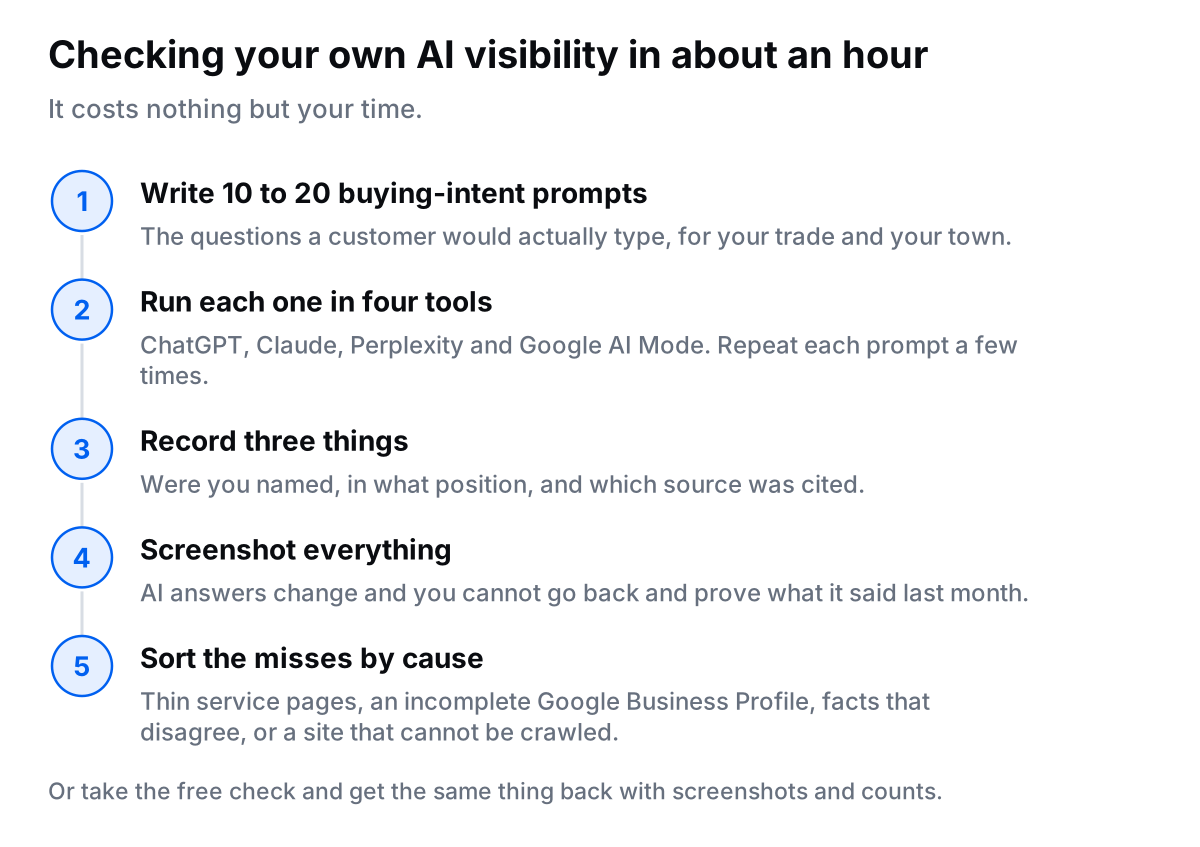
Most Irish owners have never done this. They assume that because they rank on Google, they must also turn up when someone asks an assistant for a recommendation. Often they do not. This guide is the exact self-check I run before any client call. If you would rather have it done for you, the free AI visibility check Ireland is the same method with the screenshots handed over, and the AI visibility audit Ireland service turns the findings into monthly work.
What exactly are you checking for?
Not a ranking. There is no position one in a chat answer. You are checking for three separate things, and they are worth keeping apart in your notes.
- Recognition. Does the assistant know your business exists, and does it describe it correctly? Ask it directly: "What do you know about [business name] in [town]?" If it invents services, gets your town wrong or has never heard of you, nothing else will work until that is fixed.
- Recommendation. When someone asks for the best in your trade and town, are you one of the two or three names it gives? This is the one that brings in work.
- Citation. Which page did it read? Your service page, your Google Business Profile, a directory, a review site, or a competitor's blog post about you. The cited source tells you what to improve.
A business can be recognised and still never recommended. That is the most common pattern I see, and it is usually the easiest to shift.
Which prompts should you run?
Write the questions a customer would actually type, not the keywords you would target in SEO. People talk to assistants in full sentences and they include their situation. Aim for 10 to 20 prompts in four groups.
- Trade plus town. "Best physio in Waterford", "who is a good accountant for a small business in Kilkenny", "recommend a solicitor in Tramore for a house purchase".
- Problem first. "My boiler is leaking and I am in Dungarvan, who should I ring?", "I need a dentist who can see me today near Carlow".
- Comparison and shortlist. "Compare the top three [your trade] in [your town]", "who should I get quotes from for [your service] in [your county]?"
- Your own name. "What do you know about [business name]?", "Is [business name] any good?", "What does [business name] charge?"
Keep the list in a spreadsheet and never change it. The value is in running the same set month after month so the numbers mean something. Changing the prompts resets your baseline.
How do you run the check in each tool?
Four tools cover nearly all of the traffic. Open each in a fresh browser window, logged out or in a private window where you can, so your own history does not tilt the answer.
- ChatGPT. Ask the prompt, then ask "which sources did you use?" if no links appear. Run each prompt three to ten times in new chats. The answers vary, so a single run tells you very little.
- Claude. Same method. Claude will search the web when a question needs current or local facts and will show the pages it read.
- Perplexity. The most useful of the four for diagnosis, because it always searches and always shows numbered citations. If your page is not in that list, you know the problem is discovery, not wording.
- Google AI Mode and AI Overviews. Google describes the process as a "query fan-out": it issues several related searches behind your one question and combines the results. Google states there are no extra requirements to appear in AI features beyond being indexable and useful.
Screenshot every answer, with the date visible. Name the files by prompt and tool. This is the part people skip and later regret, because you cannot reproduce an AI answer from six weeks ago.
How do you score the answers?
Keep it to four columns per prompt, per tool. Anything more and you will not keep it up.
| Column | What you record |
|---|---|
| Named | Yes or no. Count out of the number of runs, for example 3 out of 10. |
| Position | First, middle or last in the list of names given. |
| Source cited | The page or profile the tool credited, if any. |
| Competitors named | The two or three rivals that keep coming up. |
Your headline number is share of answers: mentions divided by total runs. If you were named in 6 of 40 runs, you are at 15 per cent. Track that figure monthly against your closest rival. That is the whole scoreboard, and it is the same one used on the AI search visibility retainer.
Why is your business missing from AI answers?
In practice, nearly every miss traces back to one of four causes.
1. You have no page that answers the question
A homepage that says "welcome to our website" gives an assistant nothing to quote. If someone asks about fixed-price boiler repair in Dungarvan and no page on your site states that service, that price approach and that area in plain words, there is nothing to lift.
2. Your Google Business Profile is thin or wrong
Local answers lean heavily on profile data. Google's local ranking guidance names three factors: relevance, distance and prominence. Missing categories, old hours or an empty services list all cost you. Add every service you offer, keep your hours current, and ask recent customers for honest reviews.
3. Your facts disagree across the web
Three different phone numbers, two trading names and an old address in a directory make a business look uncertain. Assistants prefer facts that agree in several places. Pick one version of your name, address, phone, hours and service list, then make every listing match it.
4. Your site cannot be read
Check your robots.txt for blocks on AI crawlers, confirm your pages are indexed, and make sure the important text is not locked inside images or loaded only by JavaScript. Google's advice on succeeding in AI search comes down to clear, original, people-first content on a clean technical setup.
What should you fix first?
Work in this order. It is roughly the order of effort against payback.
- Google Business Profile. Complete every field, add your full service list, and ask recent customers for honest reviews. An afternoon of work.
- One page per service, with the area named. Say what it is, who it suits, what it costs or how you price it, and where you cover. Plain sentences beat marketing language here.
- Consistency sweep. Fix your details on directories, review sites and social profiles so they match the site exactly.
- Answer pages and FAQs. Take the prompts from your spreadsheet and answer each one directly on your site, in the customer's words.
- Third-party mentions. A local news piece, a supplier listing or a trade body page all confirm your facts from outside your own site.
- Re-run the check. Same prompts, same tools, monthly. First mentions usually show within 6 to 12 weeks.
If your site is too old to edit, or the copy cannot be changed without ringing whoever built it, fix that first. There is no point pointing an assistant at a page you cannot update. Our guide on what a small business website needs in 2026 covers the minimum, and what AI search visibility means goes deeper on how the tools choose who to name. For the difference between the disciplines, read AI SEO vs GEO vs AEO explained, and for what it costs to fix properly see what GEO costs in Ireland.
What does an assistant read before it names a business?
ChatGPT does not keep a private list of good businesses. When a question needs current or local facts, it runs a web search, reads the top results, and writes an answer from them. Claude and Perplexity work the same way. For a small Irish business, six sources carry most of the weight.
- Your Google Business Profile. Name, category, address or service area, hours, phone, services and photos. Google's local ranking guidance is built on relevance, distance and prominence, and AI answers inherit those signals for "near me" questions.
- Reviews. Volume, recency and wording. A review that says "fixed our boiler in Tramore the same day" teaches the assistant three facts at once.
- Entity clarity on your site. Can a machine tell in one pass what you are, where you are and who you serve? "Electrician covering Waterford city and county" beats "solutions for the modern world".
- Third-party mentions. Local news, supplier pages, trade bodies, chamber listings, sponsorship pages. Each one is a vote that your facts are true.
- Directories. Golden Pages, Yelp, trade registers and sector bodies such as CIF or RECI. Same name, same phone, same address everywhere.
- Structured data. LocalBusiness markup, or a more specific type, plus FAQ markup, so a crawler cannot misread the facts on your site.
The pattern is agreement. When your site, your profile, your reviews and three other pages all say the same thing, the assistant is confident enough to name you.
What should you not do?
- Do not buy or trade reviews. Google's content policy prohibits it, and assistants read review patterns too. One removed profile costs more than a year of honest asking.
- Do not stuff pages with superlatives. "Best web designer in Ireland" ten times over reads as noise. State facts and let the reviews carry the praise.
- Do not build fake location pages. Twenty near-identical "plumber in [town]" pages hurt more than they help. One clear service-area statement does the job.
- Do not hide behind a contact form. A visible phone number, a service area and an email are trust signals for machines as much as for people.
- Do not paste generic AI text onto your site. It says nothing specific about you, which is the one thing the assistant needs.
How long does it take?
Faster than classic SEO, because the assistants re-read the web on every query. For a small Irish business starting with a working site and a claimed Google Business Profile:
- Weeks 1 to 2: baseline check, profile completed, robots.txt cleared, entity statement written, schema added.
- Weeks 3 to 8: service pages and FAQs go live. First mentions usually appear here, often in Perplexity or Google AI Mode first.
- Months 3 to 6: steady coverage across the tools as reviews and mentions build. Crowded categories, such as solicitors, dentists and estate agents in a city, take longer.
There is no dashboard for ChatGPT, so you build one. Keep the same 20 questions, ask them in ChatGPT, Claude, Perplexity and Google AI Mode once a month, and record whether you were named, where you sat in the list, and what was cited. The count month on month is your scoreboard.
Have the check run for you
The free AI visibility check runs your buying-intent questions ten times each across ChatGPT, Claude and Google's AI. You get the screenshots, the counts and the competitor names, plus a three-minute video. Then read how the AI search visibility retainer works, or book a free call.
Frequently asked questions
How do I check if ChatGPT recommends my business?
Open a new chat, ask for the best business in your trade and town, and repeat the same prompt three to ten times in fresh chats. Note whether you are named and which source is cited, and screenshot each answer with the date visible.
Why does ChatGPT give a different answer every time?
The models are not deterministic and they re-read the web on each query. That is why one run tells you nothing. Run each prompt several times and record how many times out of ten you were named.
Should I log out before running the check?
Yes, or use a private window. Your own chat history and location can tilt the answer towards businesses you have already looked at, which makes your visibility look better than it is.
What if the AI does not know my business at all?
Start with recognition rather than recommendation. Complete your Google Business Profile, publish one clear page per service with your area named, and make your name, address and phone number match everywhere they appear online.
Can I pay ChatGPT to recommend my business?
No. There is no paid placement inside ChatGPT answers. The assistant builds each answer from what it can read on the web. The only way in is to be clear, consistent and well reviewed across your site, your Google Business Profile and third-party pages.
Does my business need a website to be recommended by ChatGPT?
It helps a great deal. A Google Business Profile alone can get you named for some local questions, but a site with clear service pages is what the assistant quotes when it explains why you fit. A one-page site with the right facts is enough to start.
Should I block AI crawlers in robots.txt?
Not if you want to be recommended. If you block OAI-SearchBot, ClaudeBot, PerplexityBot or Google-Extended, the assistant cannot read your pages and will quote someone else instead. Check your robots.txt and any WordPress security plugin settings.
Do reviews matter for ChatGPT recommendations?
Yes. Reviews are structured, third-party evidence that you exist and do good work, and assistants lean on them for local questions. Ask every customer for an honest review and answer each one, good or bad.
Is the FMOps AI visibility check really free?
Yes. I run the buying-intent questions ten times each across ChatGPT, Claude and Google's AI by hand, and you get the screenshots and the counts. Retainers start from €750 a month if you want the ongoing work, but the check comes with no obligation.

Fionn Murphy runs FMOps, a one-person consultancy in Waterford, Ireland. He helps small Irish businesses get found in AI search, ship simple websites, automate admin, and set up Claude for their teams. LinkedIn · Book a free 30-minute call